Why the experts were wrong about the death of cinema & publishing
The data says cinema and books are booming. Here's the part the experts never saw coming - it was never about the content

For the last decade, the experts have told me the same three things on repeat:
streaming was going to kill cinemas.
YouTube was going to kill books.
And all any of us would ever want again was everything shorter, faster and more personalised.
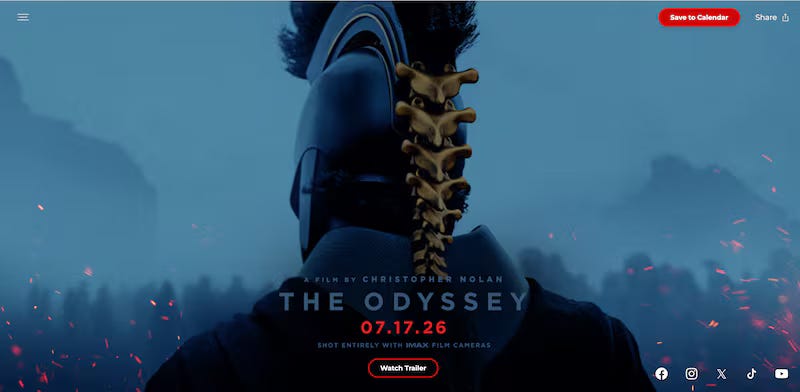
And yet here I am, unable to get a booking for The Odyssey for the next two weeks. Here I am, a couple months into a company book club I genuinely didn’t think I’d stick with, still buzzing about what we’re discussing on a Wednesday night.
Just to back up what I’m feeling with something more than just my theories: despite years of predictions that digital media would flatten physical culture, UK publishing generated a record £7.4 billion in revenue in 2025 - the highest in its history. And global box office reached an estimated $33.6 billion the same year, up 6% year-on-year, the second-highest grossing year since 2019.
So before I get on my high horse: the experts weren’t fully wrong. They just misunderstood how this would evolve. Content is still changing. How we consume it is changing. But I think as we’ve become lonelier, what we actually want is the return of shared experience. The experts assumed technology would always win, because they treated entertainment as a problem of convenience.
Culture was never a convenience problem.
It was always a meaning problem.
The prediction wasn’t wrong about technology. It was wrong about people.
The convenience era is ending
For a long time we’ve convinced ourselves that anything done quicker, with less friction, is automatically the better version. If you’ve read anything else I’ve written recently, you’ll know I’ve become a little obsessed with our addiction to optimisation, and how it’s starting to unravel. I think the same story is playing out here.
We optimised our productivity. Then we optimised how we consume. Blockbuster died at the end of the noughties and Netflix took the throne. By the time Covid hit, we’d already been told cinema was on its way out - why would anyone pay for a ticket, get in thier car and a queue for popcorn when the whole of Netflix was one login away? Boxsets replaced films because we didn’t want a two-hour story, we wanted an entire weekend we binge on something. Convenience was how we spent our evenings.
What nobody factored in was the most obvious consequence of all: when everything is instantly available, nothing feels special.
In talent management, you never want a client to feel oversaturated - it strips the scarcity, and scarcity is most of what makes anyone or anything feel rare. I think the same logic applies to how we’ve been living. We devoured so much content, so much of it short-form and disposable, that the novelty rotted (the real brain rot). And now we’re crawling back toward anything that feels less like a transaction and more like a ritual.
The return of the water cooler moment
This is something I’ve banged on about before, and something I think properly returned to British culture because of The Traitors.
A water cooler moment is exactly what it sounds like: the conversation in the office the next morning after something happened on TV the night before, and everyone in the building already knows what you’re talking about because they watched it too. I have genuinely fond memories of running into school buzzing to talk about the X Factor results from the night before, and later, in my twenties, cramming half my friend group onto my sofa every Monday for the next episode of Game of Thrones.
We lost that almost entirely. Not because we stopped watching things, but because we stopped watching them together, or even at the same time. It became impossible to build a water cooler moment when, by the time I’d finished a series and wanted to talk about it, my friend had watched it a month earlier and moved on. The buzz had already died. You can’t build a fire from sparks that keep missing each other.
But the industry noticed too. I remember being genuinely surprised that Amazon Prime was releasing The Summer I Turned Pretty weekly rather than dropping the whole season at once - until I realised the entire audience was hosting viewing parties with their girlfriends, and it clicked instantly. Why would you kill that buzz? Why wouldn’t you want a whole fandom spending a week arguing over Jeremiah versus Conrad before the next episode dropped?
That’s not a scheduling decision. That’s momentum, built on purpose.
Publishing worked out the same trick from the opposite direction. BookTok didn’t just sell books, it built book clubs, first online and then in real rooms, with people reading the same novel over the same summer so they’d have something to talk about when they saw each other. Slower than a Monday morning at the office, but the same instinct.
And it isn’t only television and books. 2025 gave us the clearest possible proof of the theory: Oasis reunion tickets sold out in minutes , because nobody wanted to be the one person who wasn’t there when everyone else was singing Wonderwall back at Liam and Noel. None of it succeeded purely on the content. It succeeded because it became an event.
People dressed up for it. They debated it online for weeks beforehand. They made the memes. They booked months ahead. They talked about it for days afterwards. Cinema had its own version of this only two summers ago, when Barbie and Oppenheimer landed on the same release date and an entire internet decided, apparently by consensus, that you weren’t allowed to see one without the other. Barbenheimer wasn’t a marketing masterstroke dreamed up in a boardroom. It was the audience building its own event out of two films that had nothing to do with each other, because we were starving for an excuse to all be doing the same thing on the same weekend.
AI is making us want to be more human
So why is this actually happening? I think it comes down to one uncomfortable irony: the more digital life becomes, the more valuable a human experience becomes by comparison.
Algorithms were supposed to give us more of what we wanted. And they did - they personalised culture down to the individual. The unintended side effect is that they fragmented it at the same time. My feed and your feed have almost nothing in common any more. We can spend hours a day consuming content and never once consume the same thing as the person sitting next to us.
Then AI arrived and made the personalisation problem worse by making content itself nearly free. I wrote a few months ago about an AI-generated fruit version of Love Island that racked up three hundred million views on TikTok in under a month, made by one person in about three hours an episode. It proved something important: AI can generate almost infinite content, cheaply and instantly. Which means the moment anything becomes infinite and instant, it also becomes disposable. And whatever AI can’t replicate - the things that require another actual human being to be in the room - becomes the premium product almost by default.
Being in a packed cinema when one hundred strangers gasp at the same moment. Laughing at the same joke as someone you’ve never met sitting next to you. Holding a physical book that a friend recommended to you specifically, not an algorithm. Queuing for a gig you could just as easily watch clips of the next morning, the way half the internet did with the Eras Tour, because a video never comes close to actually being there. Presence has become scarce. And scarcity is what creates value - that hasn’t changed since long before any of us were online.
I don’t think this is really about films or books at all. I think it’s about loneliness, and I don’t think we’re always honest about saying so. We are more surrounded by content than any generation in history, and yet most of us consume almost all of it completely alone - through headphones, in bedrooms, on commutes, scrolling a phone in bed at midnight instead of talking to the person next to us. A cinema is one of the few remaining places where several hundred strangers silently agree to feel something together, at the same time, for two hours, without any of them having to perform it for anyone else’s feed afterwards. That is an increasingly rare thing to be offered. I suspect that’s the real thing people are paying for when they buy a ticket.
Maybe we never wanted infinite choice
For the best part of two decades, Silicon Valley promised us infinite choice.
But nobody builds a memory out of an infinite scroll. We build memories out of finite moments: a packed cinema on opening night, a midnight book launch, a sold-out gig where you couldn’t hear yourself sing along. Nobody comes home from a night out and tells the story of the seventeen shows they could have watched instead. We tell the story of the one we actually turned up for, with other people, at a time we didn’t get to choose.
I think the experts were tracking the wrong graph the whole time. They were tracking convenience, when they should have been tracking connection. And the industries quietly thriving right now - cinema, publishing, live music, live television - are the ones that worked out, sometimes by accident, that scarcity was never the enemy of culture. It was the ingredient they’d optimised out of it.
Maybe the real luxury was never having everything, whenever we wanted it. Maybe it was always having something worth waiting for, with someone worth waiting with.
So here’s the uncomfortable question underneath all of this: if convenience was never actually what we wanted, how much of the rest of our lives have we optimised for exactly the wrong thing?
What’s the last thing you queued for, booked weeks ahead, or waited a week to watch - and did it feel better because you had to wait? I’d love to know.
Fantastic writing! You made my day. We have been talking of “bringing people together” as our only vision for films, animation, games and theme parks. All the businesses we are busy building here in India. Thank you.
Great article (See I do read your Substack!) Going to the cinema is one of my favourite things to do as I can properly switch off. As the Odyssey was fully sold out this weekend, went to see the Invite which was brilliant - highly recommend!